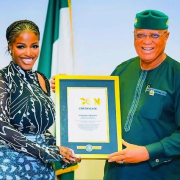
Hilda Baci Receives Governor Eno’s Commendation for Record-Breaking Feat

Akwa Ibom State Governor Umo Eno has applauded chef Hilda Baci for her achievements and the recognition her culinary career has brought to the state.

Baci, an indigene of Akwa Ibom and Guinness World Record holder, was received by the governor at the Government House in Uyo.

Eno said her story demonstrated how boldness, determination and commitment could enable individuals to overcome obstacles and accomplish significant feats.

The governor also praised Baci for projecting Akwa Ibom through her culinary exploits and encouraged her to continue promoting the state wherever her activities take her.

During the visit, Baci praised the development taking place across Akwa Ibom under the Eno-led ARISE administration.

She highlighted the state’s infrastructure, peaceful atmosphere and investment opportunities, saying the combination provided opportunities for businesses, tourists and investors.

Speaking to the Government House Press Corps, Baci described Akwa Ibom as “amazingly beautiful” and commended Governor Eno’s vision and leadership.

She expressed particular admiration for the Victor Attah International Airport, describing its facilities as first-rate and impressive.

Read Also: Olu Jacobs: 1942–2026 — The Actor Who Survived Years of Death Rumours

The chef also praised the hospitality and industriousness of Akwa Ibom residents and expressed readiness to collaborate with relevant stakeholders to support the state’s development.

Baci called on tourists and investors to explore the state’s environmental attractions, recreational opportunities, hospitality sector and other areas with investment potential.

She said these opportunities could provide avenues for businesses to grow and maximise their potential.

Baci presented her Guinness World Record certificate to Governor Eno during the visit.

She also urged Akwa Ibom residents to maintain peace, unity and love, stressing that a peaceful environment is important for attracting investment and supporting sustainable development.

Among those present were First Lady’s Office Coordinator Helen Eno Obareki, House Speaker Udeme Otong, SSG Enobong Uwah, Information Commissioner Aniekan Umanah, Culture and Tourism Commissioner Anieti Udofia, Hotels and Tourism Board Chairman Ime Udo and other government officials.

Olu Jacobs: 1942–2026 — The Actor Who Survived Years of Death Rumours

Before his exit , veteran actor Oludotun Baiyewu Jacobs, popularly known as Olu Jacobs, had repeatedly been announced dead by fake social media blogs and feeder websites.

However, yesterday, his son, Olusoji Jacobs, in a collaboration post with his father’s wife, Joke Silva, shared the shocking news.

“It is with gratitude to God for a life well lived and fought, that we announce the passing of our dear husband, father, grandfather and uncle. The Lion of Lufodo,” the post read in part.

The announcement came from the rightful source. No correction. No family denial and no video of the actor appearing to prove the reports wrong.

Olu Jacobs, born on July 11, 1942, died at 84.

The announcement brings to an end not only the life of one of Nigeria’s most excellent character interpreters but also a peculiar chapter in the history of Nigerian celebrity culture: years of false reports announcing his death. DownloadInteractive Maps

Egba heritage, Kano-raised, England-trained

Born in 1942 to parents of Egba Alake heritage, Jacobs spent part of his childhood in Kano, where he attended Holy Trinity School and participated in debating and drama.

His interest in acting was reportedly strengthened after watching one of Chief Hubert Ogunde’s concert parties at the Colonial Hotel in Kano.

He eventually travelled to England and trained at the Royal Academy of Dramatic Art (RADA), London.

Jacobs began building his reputation on the British stage and television before becoming a familiar face in international productions.

His early stage career included a role in A Taste of Honey at the Crucible Theatre in Sheffield in 1972.

He subsequently appeared in British television productions including The Goodies, Till Death Us Do Part, Barlow at Large, The Venturers, Angels, The Tomorrow People and The Professionals.

In 1978, he played President Mageeba in Tom Stoppard’s Night and Day.

His international film credits included The Dogs of War, Roman Polanski’s Pirates and Baby: Secret of the Lost Legend. Lufodo Group’s official biography also records his work with organisations including the BBC, National Theatre, Royal Shakespeare Company, Universal Pictures, MGM and Walt Disney.

But Jacobs eventually chose to return home.

The Nigerian chapter DownloadInteractive Maps

Upon his return to Nigeria in 1990, Olu Jacobs starred in the NTA detective series The Third Eye, which helped establish the foundation for the career for which he would become best known. Jacobs became one of the familiar faces of Nigeria’s emerging television and film industry, eventually becoming one of the veteran actors associated with the development of Nollywood.

Read Also: Nigerians Debate Daughters’ Rights to Family Property and Inheritance

His deep voice, commanding presence and ability to portray authority figures made him particularly memorable in roles as fathers, elders, traditional rulers, politicians and other figures of influence.
He appeared in more than 100 Nigerian films, with credits including Oloibiri and The Royal Hibiscus Hotel. Lufodo Group, which he co-founded, says his body of work spans stage, film and radio and includes more than 300 Nigerian movies.

Lufodo Academy of Performing Arts was established to train performers and raise professional standards in stage, television and film production.

The honours

His contribution to the arts brought numerous recognitions.

Jacobs won the African Movie Academy Award for Best Actor in a Leading Role for Dancing Heart in 2007. He was honoured with the Industry Merit Award for outstanding achievement in acting at the 2013 Africa Magic Viewers’ Choice Awards and an AMAA Lifetime Achievement Award in 2016.

In 2011, the Federal Government conferred on him the national honour of Member of the Order of the Federal Republic (MFR).

In November 2021, after another wave of reports that he had died, Jacobs appeared at the Africa International Film Festival, where he received a Lifetime Achievement Award. The appearance provided perhaps the most dramatic rebuttal to the rumours that had dogged him.

A final goodbye

Olu Jacobs leaves behind a body of work, a great personality and an institution-building legacy that extended beyond the screen.

The man whom colleagues and admirers in the movie industry fondly called “Uncle Olu” is now finally gone.

Nigerians Debate Daughters’ Rights to Family Property and Inheritance

A woman’s refusal to contribute about ₦1.5 million to her father’s village building project because she said she would not inherit the property has sparked a wider conversation about family responsibility, culture, inheritance and the expectations placed on daughters.

The woman, who identified herself as Ikwerre, said she had initially planned to support her father’s building project with about $1,000, which she estimated at about ₦1.5 million at the time. According to her account, she later asked whether she would inherit part of the building if her father died and was told that she could not inherit it because she was a woman under their tradition. She said she could instead be given a room or space to stay whenever she visited.

She subsequently withdrew her planned contribution, saying the male children who would inherit the property should contribute to its construction. She, however, stressed that her decision did not mean she would stop supporting her father personally. She said she had continued to give him money when necessary, including sending him money for his birthday.

The controversy raises a question that goes beyond the particular family: should a daughter be expected to financially contribute to a family property if she has no right to inherit it?

For young woman Happiness Christopher, the issue should not necessarily be viewed through the expectation of inheritance. She said daughters should not feel entitled to their parents’ properties simply because they are children of the family.

“As a female daughter, we shouldn’t feel entitled to the properties,” Christopher said.

Her position, however, was not that daughters should ignore their parents’ needs. Rather, she spoke about supporting parents out of concern for their welfare, while also stressing the importance of being financially stable before taking on family responsibilities.

Christopher’s view brings another dimension to the debate. For her, helping parents should not always be treated as an investment made with the expectation of receiving property in return. At the same time, she cautioned against giving beyond one’s means, stressing the need for individuals to take care of themselves before supporting others.

Gloria Anthony, another young woman who reacted to the issue, did not make a lengthy argument of her own. She acknowledged Christopher’s expression on the matter before offering a brief piece of advice centred on supporting and caring for one’s parents.

Her contribution, though brief, reinforced one of the competing ideas at the heart of the debate: whether responsibility towards parents should remain separate from expectations about inheritance.

For Obehi Onjnlui, a businesswoman, the issue also touches on women’s experiences within traditional family structures. Speaking from a personal perspective, she reflected on the way cultural expectations can affect a woman’s relationship with her family home after marriage.

Her experience adds a human dimension to the debate, showing that questions surrounding inheritance are not only about land and buildings but can also involve belonging, family identity and the changing position of women within traditional households.

The men interviewed also brought their perspectives to the discussion. Emmanuel Okorie questioned the fairness of excluding a daughter from family inheritance while still considering her part of the family when responsibility and contribution are required. He acknowledged the place of culture and tradition but argued from the standpoint of fairness and equity within the family.

Read Also: I Have My Integrity – Patience Ozokwor Names Presidential Candidate She Is Backing

Ofaine Williams Akatu also contributed a male perspective to the discussion, adding to the broader conversation about whether existing cultural expectations around daughters, inheritance and family property should continue without reconsideration.

The different reactions show that the issue is not as simple as choosing between “inheritance” and “contribution.” For some, children have a responsibility to support their parents regardless of what they may eventually inherit. For others, asking a child to finance property from which that child is deliberately excluded raises a question of fairness.

For daughters in particular, the debate touches on a difficult balance between family responsibility and personal financial independence. A daughter may want to support her parents because they are her parents, while still questioning whether her contribution should go towards an asset from which she has no recognised inheritance rights.

The viral woman’s decision has therefore opened a much larger conversation about what families owe their daughters, what daughters owe their parents and whether traditions governing inheritance should influence the financial responsibilities of children.

Ultimately, the question remains: if daughters are expected to contribute to building family property, should they also have an equal right to inherit it?

I Have My Integrity – Patience Ozokwor Names Presidential Candidate She Is Backing

Veteran Nollywood actress Patience Ozokwor, widely known as Mama G, has publicly expressed her support for Peter Obi ahead of Nigeria’s 2027 presidential election.

Ozokwor made her position known while attending an event organised under the banner “Celebrities for Peter Obi,” where she joined other participants discussing the country’s political and socio-economic situation.

During her remarks, the actress spoke about Nigeria’s abundant natural and human resources, expressing concern that the country had not fully translated its wealth into improved living conditions for many citizens.

Ozokwor said she viewed Nigeria as a country richly blessed with resources, noting that several nations with fewer natural endowments had made significant progress in improving the welfare of their people.

She also drew attention to the disparity between wealthy Nigerians and citizens struggling to meet their everyday needs.

Read Also: Kunle Remi: My Wife Can’t Kneel for Every Elderly Person

According to the actress, some Nigerians have accumulated substantial wealth capable of supporting their children, grandchildren and even future generations, while other citizens continue to experience economic difficulties.

“I see this country as a spoiled child. There is nothing God did not provide for us,” Ozokwor said while describing her concerns about the nation’s development.

She argued that countries possessing only a fraction of Nigeria’s resources could have achieved greater development if they had access to similar opportunities.

The veteran actress further spoke about the position of celebrities in society, saying public figures may not necessarily have political power but possess their reputation and integrity.

“Celebrities here, what we have, we have our faces. We have our integrity. I have mine,” she said.

Ozokwor’s comments add her voice to the growing political activities and public discussions surrounding the 2027 presidential election.

Her appearance at the “Celebrities for Peter Obi” event also places her among entertainers who have publicly associated themselves with the former Anambra State governor ahead of the election.

Kunle Remi: My Wife Can’t Kneel for Every Elderly Person

Nollywood actor Kunle Remi has opened up about his wife, Tiwi, and her approach to showing respect to older people
It was reported that the actor explained that his wife does not consider kneeling before every elderly person necessary when greeting them.Nigeria News Subscription

According to him, she reserves the practice for older relatives and people who are particularly close to her.

Remi shared the details during an interview with VJ Adams while speaking about his marriage and some of the differences between him and his wife.
He said Tiwi is comfortable kneeling when greeting her grandparents and parents but does not follow the practice whenever she meets an elderly person.

Read Also: “I Felt Like a Failure” – Spyro Reveals Emotional Impact of His Father’s Actions

Remi also spoke warmly about his relationship with his wife, describing her as his best friend and discussing how his faith influenced his decision to get married.

He recalled that his prayers before marriage included asking God to reveal things he did not know and guide him on matters he needed to understand.

The actor also said he prayed with the intention of being prepared to care for the woman who would eventually become his wife.

He said, “My wife doesn’t even understand what kneeling means; she can kneel for her grandparents, her parents, but can’t kneel for every elderly person. My prayer was, God, show me what I don’t know and teach me what I need to know. I’m ready to take care of the woman that will be my wife.”

“I Felt Like a Failure” – Spyro Reveals Emotional Impact of His Father’s Actions

Nigerian singer Spyro has opened up on the painful experiences from his childhood, recalling how repeated accusations and punishments from his pastor father affected his confidence.
It was reported that the singer in an interview on Nevon HQ said his father would accuse him of stealing whenever money went missing in church and publicly portray him as a troublesome child.

According to Spyro, the embarrassment would sometimes be followed by gestures such as buying him milk after the missing item or money was eventually found, but he said such gestures did not erase the damage caused by the public accusations.

He said, “My dad is a pastor. He will tell outsiders that this boy is a thief. The way he paints you in the midst of people, once money goes missing in church, he will point to me in church.

Read Also: 10 Iconic Movies That Featured Late Nollywood Veteran Olu Jacobs

“All the public embarrassment, and then when he eventually finds what he’s looking for, he buys you milk. What is milk supposed to do to the damage that has been done?”

Spyro also recalled an incident from his childhood involving a school cleaner, which he said remains one of the experiences that still brings tears to his eyes.

He explained that he once told his father that a school cleaner had scratched his head with her long nails. However, his father allegedly accused him of lying.

“There’s a particular thing that happened, and anytime I think about it, it gets me teary always. I broke up with my dad after I told him a school cleaner scratched my head with her long nails, but he called me a liar.

“We went to confront her, and she denied knowing me. When we got home, my dad flogged me to stupor and left a mark that’s still on my back 22 years later. It broke me because I told this man the truth, and I suffered for it,” he said.

10 Iconic Movies That Featured Late Nollywood Veteran Olu Jacobs

The death of veteran Nigerian actor and film executive Olu Jacobs at the age of 84 has renewed attention on a remarkable acting career that spanned more than five decades and crossed several continents.

Jacobs, whose full name was Oludotun Baiyewu Jacobs, died on September 16, 2026. His passing marked the end of an era for an actor whose career extended from British theatre and international cinema to the development of modern Nollywood.

Long before becoming one of the most recognisable faces in Nigerian film, Jacobs trained at the Royal Academy of Dramatic Art in London. He subsequently worked in British theatre and television before securing roles in international film productions.

His career featured a wide range of performances, including adventure films, historical dramas, thrillers, social-issue productions and romantic comedies.

Here are 10 films that highlight different stages of Jacobs’ extensive career.

1. Ashanti — 1979

One of Jacobs’ earliest recorded screen appearances came in the 1979 adventure film Ashanti. The production featured international stars including Michael Caine, Peter Ustinov and Kabir Bedi.

Jacobs portrayed Commissioner Batak in the film, marking an early chapter in his international screen career.

At the time, Nigeria’s modern film industry had not yet developed into the global entertainment force it would eventually become, making Jacobs’ international experience particularly notable.

2. The Dogs of War — 1980

Jacobs continued his international film career with The Dogs of War, released in 1980.

The movie was adapted from Frederick Forsyth’s novel and directed by John Irvin. It starred Christopher Walken and followed a group of mercenaries involved in a military operation in an unnamed African country.

Jacobs appeared as a Customs Officer, adding another international credit to his growing résumé.

3. Baby: Secret of the Lost Legend — 1985

In 1985, Jacobs featured in Baby: Secret of the Lost Legend, an adventure production from Touchstone Pictures.

He played Colonel Nsogbu in the film, which centred on researchers who encounter an undiscovered dinosaur species during an expedition in Africa.

The production further demonstrated Jacobs’ ability to work within international productions alongside actors and filmmakers from different backgrounds.

4. Pirates — 1986

Jacobs also appeared in Roman Polanski’s Pirates, released in 1986.

He played Boomako in the adventure comedy, which starred Walter Matthau as Captain Red.

The role added another international production to Jacobs’ filmography and demonstrated the range of projects he was involved in before Nigerian cinema became the dominant focus of his career.

Read Also: ‘He Would Call Me A Thief’– Spyro Opens Up On Painful Childhood Trauma, Reveals 22-Year-Old Scar From Father’s Words

A major presence in African cinema

5. Adesuwa — 2012

Decades after his early international appearances, Jacobs returned to historical African storytelling with Adesuwa.

Directed by Lancelot Imasuen, the film draws from the history and traditional setting of the Benin Kingdom. Jacobs played Ezomo.

The story follows a young woman whose experiences become connected to the political and social structures of the kingdom.

Adesuwa earned several Africa Movie Academy Awards nominations and won three awards, including Best Nigerian Film.

6. Potomanto — 2013

Jacobs took on the role of Bankole in Potomanto, a Ghanaian-Nigerian thriller directed by Shirley Frimpong-Manso.

The film centres on an investigation that exposes a criminal network involved in organ trafficking.

Jacobs appeared alongside actors including Adjetey Anang and Yvonne Okoro. The movie premiered in Ghana in December 2013.

7. The Antique — 2014

In the 2014 drama-adventure The Antique, Jacobs portrayed Oba Akpen.

The story follows a young woman who is sent to recover a sacred antique from a forbidden location, with the mission connected to the survival of a royal heir.

Directed by Darasen Richards and DJ Tee, the film featured Bimbo Akintola, Gabriel Afolayan and Funsho Adeolu alongside Jacobs.

Tackling social and political issues

8. Dry — 2015

Jacobs appeared in Stephanie Linus’ Dry, a film dealing with the consequences of child marriage.

He played a Speaker in the production, which explores the experiences of young girls affected by child marriage and examines the health and social consequences associated with the practice.

Released in 2015, the film later received recognition at the 2016 Africa Magic Viewers’ Choice Awards, where it won Best Overall Movie (Africa).

9. Oloibiri — 2016

Jacobs turned to Nigeria’s oil-producing region in Oloibiri, a 2016 film directed by Curtis Graham.

He played Timipre in the production, which explores the impact of oil exploration on communities in the Niger Delta through a fictionalised narrative connected to Oloibiri.

The film featured Richard Mofe-Damijo, Taiwo Ajai-Lycett and Daniel K. Daniel among its cast and premiered in Lagos in October 2016.

10. The Royal Hibiscus Hotel — 2017

One of Jacobs’ notable later appearances came in The Royal Hibiscus Hotel, a romantic comedy directed by Ishaya Bako.

Jacobs played Richard in the film, which follows a Nigerian chef who returns home and becomes involved in the struggle to save her family’s hotel.

The movie also featured Joke Silva, Jacobs’ wife, alongside Zainab Balogun and Kenneth Okolie.

The Royal Hibiscus Hotel was screened at the Toronto International Film Festival, adding another international platform to Jacobs’ long career.

From international adventure productions in the 1970s and 1980s to historical dramas, social-issue films and contemporary Nigerian cinema, Olu Jacobs demonstrated remarkable versatility.

His filmography crossed genres, countries and generations. His career not only established him as a respected performer but also connected different eras of African and international cinema.

As tributes continue to follow his death, these films offer a glimpse into the breadth of a career that helped make Olu Jacobs one of Nigeria’s most enduring screen figures.

‘He Would Call Me A Thief’– Spyro Opens Up On Painful Childhood Trauma, Reveals 22-Year-Old Scar From Father’s Words

Nigerian singer Spyro has opened up about a painful childhood experience involving his father, whom he described as a pastor, saying repeated accusations and punishments affected his perception of himself while growing up.

The singer shared the experience during an interview with Arise TV broadcaster Rufai Oseni, where he reflected on some of the difficult moments he experienced as a child.

Spyro alleged that whenever money went missing in church, his father would accuse him of stealing and sometimes point him out in front of other people.

According to the singer, the accusations were particularly painful because his father would later discover that he had not taken the missing money.

“My dad is a pastor. He will tell outsiders that this boy is a thief. Once money misses in church, he will point to me. All the public embarrassment, and then when he eventually finds what he’s looking for, he buys you milk,” Spyro recalled.

The singer also recounted an incident involving a school cleaner whom he alleged scratched his head with her long fingernails.

Read Also: Breaking: Veteran Nollywood actor Olu Jacobs has died at the age of 84

Spyro said that after reporting the incident to his father, he was accused of lying instead of being believed.

He claimed that his father subsequently flogged him, leaving a mark on his back that he said remained visible for 22 years.

“When we got home, my dad flogged me and left a mark that’s still on my back 22 years later. It broke me because I told this man the truth and I suffered for it,” he said.

Spyro explained that the experiences affected his self-image and made him feel that he should become the negative person his father appeared to believe he was.

He, however, credited his mother for helping him navigate the difficult period through her love and support.

“If not for the love from my mom and how she was able to constantly balance things up,” he said, noting that her presence helped counter the impact of the experiences.

Breaking: Veteran Nollywood actor Olu Jacobs has died at the age of 84

The death of the celebrated actor and film executive was announced by his family on Wednesday, September 16, 2026.

Jacobs’ wife, veteran actress Joke Silva, and their son, Olusoji Jacobs, shared the announcement through social media.

The family described the late actor as “The Lion of Lufodo” while appealing to bloggers and social media influencers to respect their privacy during the mourning period.

Olu Jacobs, whose full name was Oludotun Baiyewu Jacobs, was born on July 11, 1942.

He trained at the Royal Academy of Dramatic Art in London and went on to build a career across theatre, television and film.

Read Also: Nigerian Comedian Mr Macaroni Speaks On Why He Won’t Enter Politics

Before becoming a major figure in Nollywood, Jacobs appeared in British television productions and international movies, establishing himself as a versatile performer.

His return to Nigeria saw him become one of the country’s most respected actors, with a career that lasted for decades.

Jacobs received several recognitions for his contribution to the Nigerian and African entertainment industries.

Among his honours was the Member of the Order of the Federal Republic, MFR, which he received in 2011.

He also received the Industry Merit Award at the Africa Magic Viewers’ Choice Awards.

As an actor and film executive, Jacobs played a significant role in the development of Nigeria’s screen industry and inspired younger generations of performers.

He is survived by his wife, Joke Silva, children and grandchildren.

His passing has brought an end to the career of one of Nollywood’s most prominent veteran actors, whose body of work crossed generations and entertainment platforms.

Nigerian Comedian Mr Macaroni Speaks On Why He Won’t Enter Politics

Comedian and social commentator Mr Macaroni has opened up on why he does not intend to venture into Nigerian politics, saying the political environment can negatively affect people who were once highly respected.

The entertainer made the statement while discussing the difficulties involved in speaking out about issues affecting Nigerians.

According to him, public figures who advocate for citizens can sometimes face hostility from the same people they are trying to represent.

He said this can create a situation where someone raising legitimate concerns is portrayed as a troublesome person.

“I’m so happy about how things have been, and you keep talking, and it seems like you’re the troublesome person. The same Nigerians that you speak for turn against you,” he said.

Mr Macaroni said his observations of the political system have made him unwilling to pursue political office.

“I look at Nigeria, and I don’t think I want to get into the political space because it seems like the political space in Nigeria corrupts the very best of us,” he said.

The comedian also recalled the experiences of individuals he once admired, saying some entered politics and, according to his assessment, damaged the legacies they had built.

Read Also: Adeyanju Calls For State Of Emergency Over Fake Drugs In Nigeria

“Men that you have looked up to and you have respected, they got into politics and ruined their legacy,” he said.

He added that the current political environment does not encourage him to consider joining the sector.

Mr Macaroni also criticised what he described as Nigerians’ tendency to quickly adjust to economic difficulties.

He referred to public reactions to rising fuel prices, noting that although Nigerians may initially express anger and frustration, attention eventually shifts away from the issue.

“Everybody will just talk, one, two days, next thing, e don go, we don move on,” he said.

The comedian further questioned the popular narrative that Nigerians’ ability to survive harsh economic conditions is something to celebrate.

He argued that citizens should instead question why they are continually required to endure such difficulties.

“Nigerians take pride in telling you, ah, if you can survive in Nigeria, you can survive anywhere. It’s not something to brag about,” he said.