
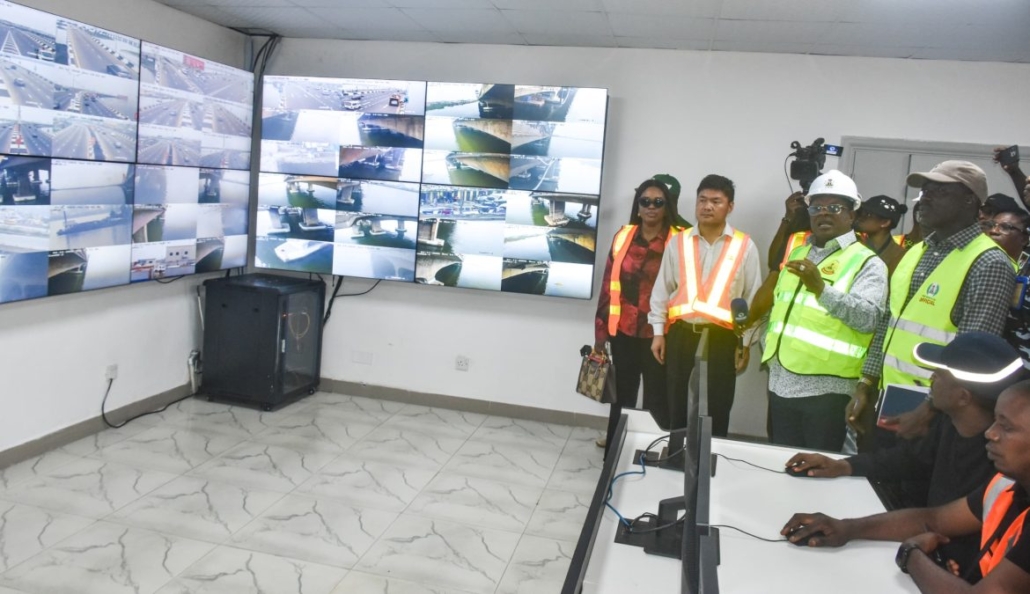
FG Launches ₦40 Billion CCTV Command Centre for Third Mainland Bridge
The Federal Government has commissioned a ₦40 billion CCTV control center on the Third Mainland Bridge in Lagos, marking a major advancement in safety, security, and infrastructure management for one of Nigeria’s busiest and most strategic roadways.
The inauguration took place on Sunday, January 11, 2026. Minister of Works Senator Dave Umahi, who officiated the event, explained that the project is the culmination of extensive rehabilitation works carried out on the bridge since the current administration assumed office in 2023. He described the condition of the bridge at that time as “very terrible,” noting that the Third Mainland Bridge, together with the nearby Carter and Iddo bridges, required thorough structural re-evaluation and repairs both above and below water level.
President Bola Tinubu approved the full rehabilitation program, which included replacement of expansion joints, resurfacing, and other critical upgrades. These interventions have significantly improved driving conditions and extended the bridge’s service life.
The CCTV system itself was first announced in 2025 and is purpose-built to address multiple safety challenges. Its primary goals are to curb reckless and excessive speeding, help prevent suicide attempts, and strengthen overall security on the bridge. Security personnel will monitor live feeds around the clock from the dedicated control centre and actively enforce speed limits. Umahi emphasized that the facility provides complete visibility: “The idea is that we can see everything that is happening on the bridge.” He also used the occasion to urge motorists to strictly obey traffic rules.
To support real-time monitoring and rapid emergency response, the contract includes the handover of one surveillance boat and two Hilux patrol vans to the Nigeria Police Force.
The Federal Controller of Works in Lagos, Olufemi Dare, described the installation as the first of its kind on any bridge in Nigeria. The system enables continuous real-time observation of activities on the bridge and in the surrounding waters. Among its advanced features are 240 solar panels paired with 10 inverters, a 300 kVA transformer, a standby generator, multiple large monitoring screens, and full air-conditioning for operator comfort. The wider scope of works also covers installation of 1,268 solar-powered street lights along the bridge and provision of a borehole facility.
The entire project was awarded at ₦40.17 billion, with roughly ₦36 billion already paid to the contractor. Sunday’s commissioning represents Phase 1; a second and final phase will be inaugurated once the ongoing bridge extension works are completed.
This development reflects the Tinubu administration’s broader commitment to modernizing federal infrastructure in Lagos while integrating sustainable energy solutions and proactive security measures. For the millions who use the Third Mainland Bridge daily, the new control centre promises safer journeys, faster incident response, and a stronger deterrent against dangerous behaviour on one of the country’s most critical transport links.









Leave a Reply
Want to join the discussion?Feel free to contribute!